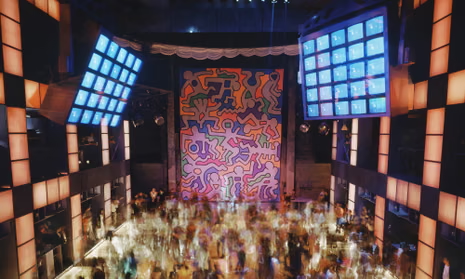
Nightlife compresses time and amplifies choice. A single hour can hold loud music, dim light, alcohol, social pressure, and fast decisions. Each factor nudges behavior. Together, they reshape how people judge risk and select entertainment.
In daylight, decisions move slowly. People compare options, check prices, and weigh outcomes. At night, the same process shortens. Choices become physical. A crowded room pushes the body forward. A flashing screen pulls the eye. A friend’s suggestion lands with more force than logic.
This shift is not random. It follows a pattern. Night settings reduce friction. They remove pauses. They reward speed. The brain adapts by favoring quick, emotional decisions over careful analysis.
Consider a simple example. A person would not spend money on a high-risk game at noon without research. At midnight, in a loud venue, the same person may act within seconds. The environment changes the threshold for action.
Three forces drive this change:
- Sensory overload reduces focus and limits deep thinking
- Social proximity increases imitation and group alignment
- Time pressure makes delay feel like loss
These forces do not just affect gambling or spending. They shape all forms of nightlife entertainment. Music choices. Venue hopping. App usage. Even the decision to stay out longer than planned.
This article breaks down how these forces work. It explains why risk feels smaller at night. It shows how environments guide behavior without clear signals. And it connects physical nightlife with digital entertainment systems that mirror the same patterns.
Understanding this system is not about control. It is about clarity. When you see the mechanics, the decisions stop feeling random. They become predictable.
Next, we examine how sensory conditions—light, sound, and space—alter perception and decision speed.
How Sensory Conditions Shape Perception And Speed Up Decisions
Nightlife changes how the body reads the world. Light dims. Sound rises. Space tightens. Each shift reduces precision and increases speed.
Low light removes detail. Faces blur. Distances shrink. The brain fills gaps with assumptions. It stops checking and starts reacting. This makes fast choices feel natural, even when they carry risk.
Loud music adds pressure. It blocks inner dialogue. You cannot “think through” a decision when bass vibrations hit your chest. Instead, you act on the strongest signal in the moment. A flashing screen. A friend’s gesture. A sudden offer.
Crowded spaces amplify this effect. When people move close together, hesitation feels costly. If you pause, you lose position. You lose access. This creates a subtle push toward immediate action. The body learns to decide first and reflect later.
These conditions mirror digital systems built for late-night engagement. Bright colors, fast feedback, and constant motion create the same loop. The user does not analyze. The user responds.
At this point, information becomes secondary. Action becomes the goal. A person scrolling through options may not read full details. They tap, swipe, or commit based on surface cues. The design rewards momentum, not accuracy.
This is where external prompts gain power. A single well-placed cue can redirect behavior. A quick suggestion to read more can shift attention instantly, especially when it appears in a high-stimulation context. The user follows the path without stopping to evaluate alternatives.
The result is a compressed decision cycle. Input, reaction, outcome. No pause in between.
In daylight, a decision feels like a sequence. At night, it feels like a reflex.
Next, we explore how social dynamics—groups, imitation, and shared energy—intensify risk-taking behavior.
How Social Dynamics Amplify Risk-Taking Behavior
People rarely act alone at night. They move in groups. They watch each other. They adjust in real time. This creates a feedback loop where behavior spreads fast.
A single action can set the tone. One person orders another round. Others follow. One person opens a betting app. Others lean in. The group does not vote. It aligns.
This process is imitation under pressure. In a quiet setting, people resist. They compare options. In a crowded venue, resistance feels like friction. Going along feels smooth.
Energy drives this shift. When a room is loud and active, calm choices feel out of place. The body seeks match, not balance. If the group moves faster, the individual speeds up.
There is also a clear reward system. Social approval arrives quickly. A bold decision earns attention. A cautious one fades. Over time, the brain links risk with recognition.
This effect grows stronger with alcohol. It lowers inhibition. It narrows focus. It makes immediate rewards feel larger than delayed outcomes. In a group, this does not cancel out. It compounds.
Small cues matter here:
- Eye contact signals approval
- Laughter reduces perceived risk
- Shared screens create joint commitment
These cues replace analysis. A person does not ask, “Is this a good choice?” They ask, “Does this fit the moment?”
Digital platforms copy this structure. Live chats, shared bets, visible actions. They simulate group presence even when the user is alone. The result is the same: faster decisions, higher risk tolerance.
In this environment, independence shrinks. Behavior becomes synchronized. Not forced, but guided.
Next, we examine how time pressure and late-night framing make delay feel like loss—and push people toward immediate action.
How Time Pressure Turns Delay Into Loss
Nightlife runs on a clock you cannot see. Venues close. Offers expire. Energy peaks and drops. This creates a constant sense that time is slipping.
In this setting, delay feels like loss. If you wait, you miss the moment. A drink deal ends. A table fills. A game round closes. The cost of waiting becomes visible, while the cost of acting stays hidden.
This flips normal logic. During the day, people avoid bad outcomes. At night, they chase disappearing chances. The question shifts from “Is this worth it?” to “Will I miss out?”
The brain uses simple shortcuts under pressure. It favors now over later. It values access over accuracy. A fast decision feels safer than a missed one.
Short cycles reinforce this pattern. Many nightlife systems run on quick rounds. A song lasts three minutes. A queue moves in seconds. A digital game resets instantly. Each loop trains the same response: act before the window closes.
Scarcity signals make this stronger. Limited seats. Limited-time offers. Countdown timers. These signals do not need to be real. They only need to feel real. Once the clock appears, hesitation drops.
Physical and digital environments use the same triggers:
- Countdowns create urgency
- Queues signal limited access
- Flash offers reward immediate action
Under these conditions, reflection feels slow. Action feels efficient. A person who pauses risks falling out of sync with the environment.
Over time, this reshapes habits. The user learns to move quickly, decide quickly, and accept outcomes without review. The goal is not the best choice. It is the timely one.
In daylight, time supports thinking. At night, time competes with it.
Next, we connect these patterns to digital entertainment systems that replicate nightlife mechanics at scale.
How Digital Platforms Replicate Nightlife Mechanics At Scale
Digital platforms do not copy nightlife by accident. They rebuild its core signals in code. Light, sound, speed, and social cues appear on a screen in tighter loops.
First, they control stimulus density. Bright colors, motion, and sound cues arrive in bursts. Each element competes for attention. Together, they crowd out reflection. The user reacts instead of evaluates.
Second, they shorten feedback cycles. Actions produce instant results. Tap, result. Swipe, result. This mirrors the fast loops of a busy venue. The brain learns that quick input leads to quick reward.
Third, they simulate social presence. Live feeds, chat windows, and visible actions create a sense of group activity. Even when alone, the user feels watched or joined. This raises alignment pressure and speeds decisions.
Fourth, they introduce structured urgency. Timers, limited rounds, and rotating offers create moving targets. The user tracks time instead of value. Delay feels like a missed window.
These systems combine into a simple loop:
- Cue appears (flash, sound, message)
- Action follows (tap, bet, join)
- Result returns (win, loss, near miss)
- Next cue loads without pause
The loop removes gaps. Without gaps, there is no space to compare options. The user stays inside motion.
Platforms also use near-miss design. Outcomes that look close to a win keep attention high. The brain reads them as progress, not loss. This sustains engagement without increasing clarity.
Personalization adds another layer. The system tracks behavior and adjusts cues. It shows what the user tends to follow. Over time, the interface becomes a tailored version of a crowded room, with fewer distractions and stronger signals.
The key point is scale. A physical venue can influence dozens of people at once. A digital system can influence millions, each with a custom feed. The same mechanics apply, but the reach expands.
Nightlife trains the pattern. Digital platforms extend it. Both rely on speed, pressure, and reward to guide choice.
Next, we conclude by outlining how awareness of these mechanisms changes decision quality without removing enjoyment.
Awareness Changes The Quality Of Choice
Nightlife does not force decisions. It shapes them. Light, sound, groups, and time pressure all push in the same direction: faster action with less analysis.
These forces are consistent. They appear in clubs, bars, and on screens. Once you see them, patterns become clear. A loud room speeds you up. A crowd aligns your behavior. A timer removes your pause.
Awareness creates a small gap. Not a full stop, just a moment. That moment is enough to shift from reflex to choice.
You do not need to reject the environment. You can still enjoy it. The goal is not control. It is precision. Knowing when a decision comes from you, and when it comes from the setting.
Two practical adjustments help:
- Name the trigger before acting. “This is urgency,” or “This is group pressure.”
- Add one second before committing. Even a brief pause restores balance
These steps do not slow the night. They sharpen it. Choices feel cleaner. Outcomes feel owned.
Nightlife rewards speed. Understanding its mechanics lets you keep the pace without losing clarity.